
How It Started
It began the way most obsessions do — with other people's photographs.
Through all of 2018, I found myself scrolling through the work of fellow photographers, lingering on their Milky Way images. Those sweeping arcs of light over desert landscapes and ocean cliffs. I didn't know anything about the technical side — tracking, stacking, Bortle scales, moon phases — none of it. I just knew I wanted to make images like those.
Some research told me the Milky Way core is best photographed between April and September. So I started planning for spring 2019. A night shoot. Somewhere on the California coast.
Shark Fin Cove — Spring 2019
I found that Shark Fin Cove near Santa Cruz was a popular spot for night sky photography. A dramatic rock formation, the Pacific Ocean, and relatively accessible. I convinced some friends to come along, and on a spring night in 2019, we drove down the coast.
I didn't know what to expect. I didn't know about the Milky Way core versus the fainter band. I didn't know about moon phases. I didn't know about tracking or stacking. I pointed my camera at the sky over Santa Cruz and took some pictures.
The Milky Way was faintly visible — a pale wash of light above the glow of the city. The images were noisy, the framing was uncertain, and I had no real idea what I was doing. But my friends were happy, and I thought I'd achieved something.
Looking back, I had. Not technically — those images wouldn't survive any serious scrutiny — but I'd started. That matters more than the result.
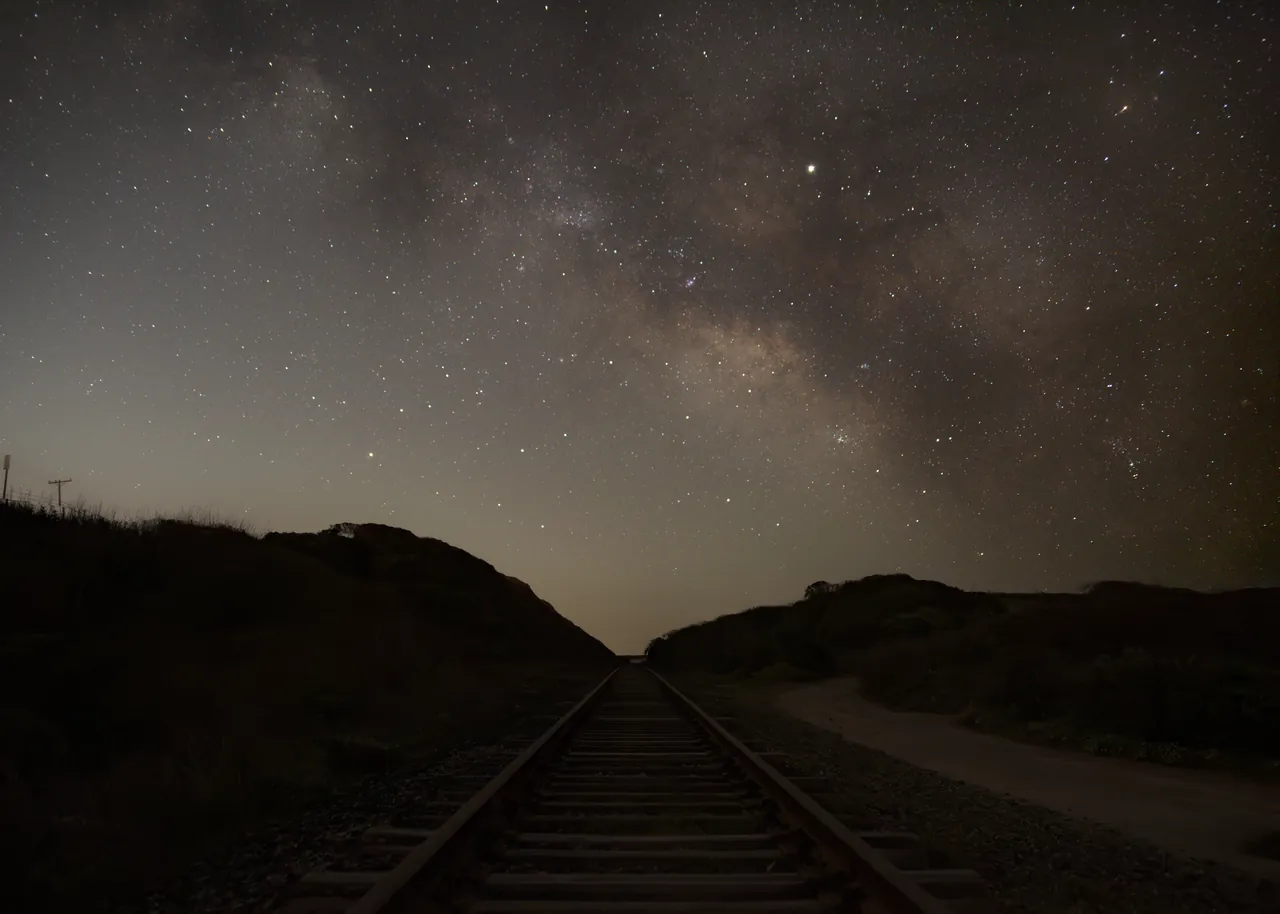
Pigeon Point Lighthouse — June 2019
Encouraged by the first outing, we went again a couple of months later. This time to Pigeon Point Lighthouse, further down the coast. I liked the composition immediately — the tall lighthouse silhouette against the sky, the Pacific stretching out behind it.
The pictures were better. Not dramatically, but noticeably. Better framing, slightly more confident settings.
What I still didn't understand was the Milky Way's schedule. I didn't know the core — the bright, dramatic center of our galaxy — is only visible for roughly six months of the year, and invisible for the other six. I didn't know to check moon phases. It happened by pure luck that the sky was clear and the moon wasn't washing everything out.
I was learning, but I didn't know what I didn't know.
The Fog Lesson
A couple of weeks after Pigeon Point, I learned something every California night photographer eventually learns: coastal fog doesn't care about your plans.
The weather forecast showed clear skies. We drove out, set up, and waited. Within an hour, thick fog rolled in off the Pacific and swallowed everything. Stars, horizon, lighthouse — all gone. We packed up and drove home with nothing.
This is coastal California. The marine layer is a force of nature that no weather app fully predicts. You check the forecast, you check the satellite imagery, and sometimes the fog comes anyway. I've since learned to factor it into every coastal session — always have a backup plan, and never drive two hours without checking multiple forecast sources.
Yosemite — September 2019
Later that September, we went on a trip to Yosemite National Park. I wasn't planning an astrophotography session specifically — it was a regular trip. But on a clear night, I left my camera out on the patio, pointed it at the sky, and started clicking.
That night changed my understanding of what was possible. Looking at those frames — still untracked, still noisy — I started asking the right questions for the first time.
Why are my images so noisy? Because each individual frame has a low signal-to-noise ratio.
How do you fix that? By stacking — combining many frames so the noise averages out and the signal accumulates.
Why do stars trail in long exposures? Because the Earth is rotating, and you need a tracker to compensate.
How do people get such clean foregrounds with a tracked sky? Software like StarryLandscapeStacker can stack the sky and foreground separately, aligning each independently.
That research led me to the MSM star tracker. By December 2019, I'd bought one.
Covid and Then Lassen — August 2020
I had plans for spring and summer 2020. The tracker was ready. I'd been reading and practicing.
Then Covid happened.
The spring Milky Way season passed in lockdown. Summer was uncertain. But by mid-2020, restrictions eased enough for outdoor trips, and my friend and I planned a trip to Lassen Volcanic National Park in August.
It became the adventure of a lifetime.
Lassen is remote, dark, and high elevation — some of the best night skies in California. For the first time, I set up the MSM rotator under real conditions. And "real conditions" meant fumbling with unfamiliar equipment in near-freezing temperatures, in the dark, with numb fingers and a headlamp that kept slipping.
Everything was harder than the YouTube tutorials suggested. Polar alignment took longer than expected. Balancing the camera on the tracker was fiddly. I couldn't tell if my settings were right because the LCD preview lies in the dark. I forgot which direction to adjust things. My fingers stopped cooperating.
But it was worth it.
The tracked images were noticeably, dramatically better than anything I'd shot before. Stars were sharper. The longer exposures pulled out structure in the Milky Way I'd never captured. And when I got home and stacked the frames for the first time, the result was leagues ahead of my untracked work from Yosemite.
It wasn't perfect. The images were "half decent" by any experienced astrophotographer's standards. But for me, standing under those stars at Lassen, hearing absolutely nothing but wind, watching the Milky Way arc overhead while my camera clicked away on the tracker — that experience was unforgettable.
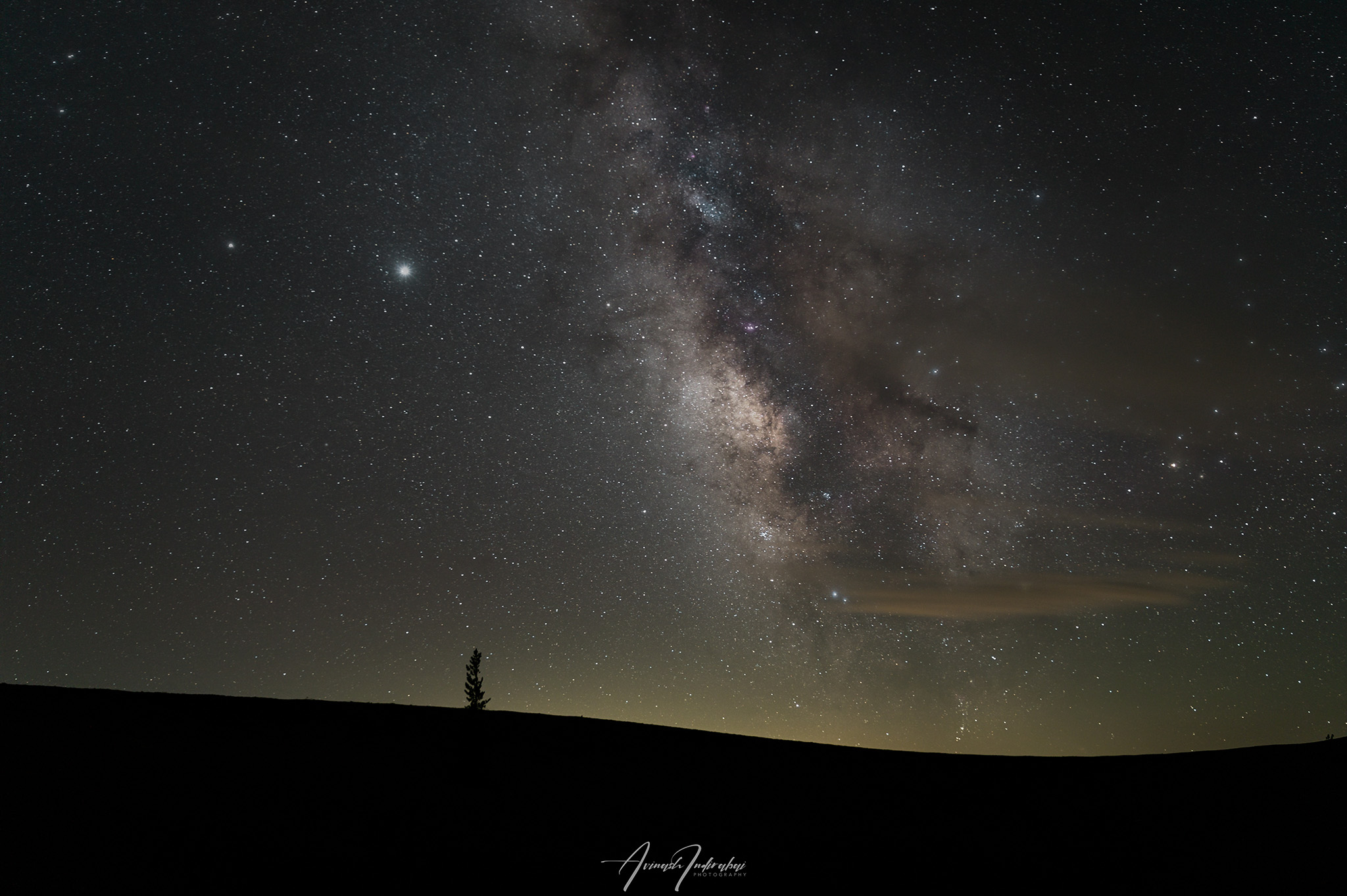
Upgrading to the Star Adventurer 2i
After the Lassen trip, I caught the upgrade bug. The MSM rotator had served me well, but I wanted something that could handle more weight — heavier lenses, a bigger camera, room to grow. This is how astrophotography works: every success convinces you that better gear will unlock the next level. And so you keep pouring money in.
I upgraded to the Sky-Watcher Star Adventurer 2i. It was a proper star tracker — more payload capacity, better build quality, and a reputation as one of the best portable trackers for DSLR astrophotography.
It took a couple of local trips around the Bay Area before I got comfortable with it. The 2i was a step up from the MSM in every way, but that also meant more to learn — different polar alignment process, different balancing, different quirks. I was still shooting Milky Way wide-field, still learning the basics. I hadn't attempted any deep sky targets yet. That was the plan, but plans have a way of not working out.
Alabama Hills and Ancient Bristlecone — Finding My Rhythm
Some of the most memorable trips from this period were to Alabama Hills and the Ancient Bristlecone Pine Forest — two of the most otherworldly landscapes in California.
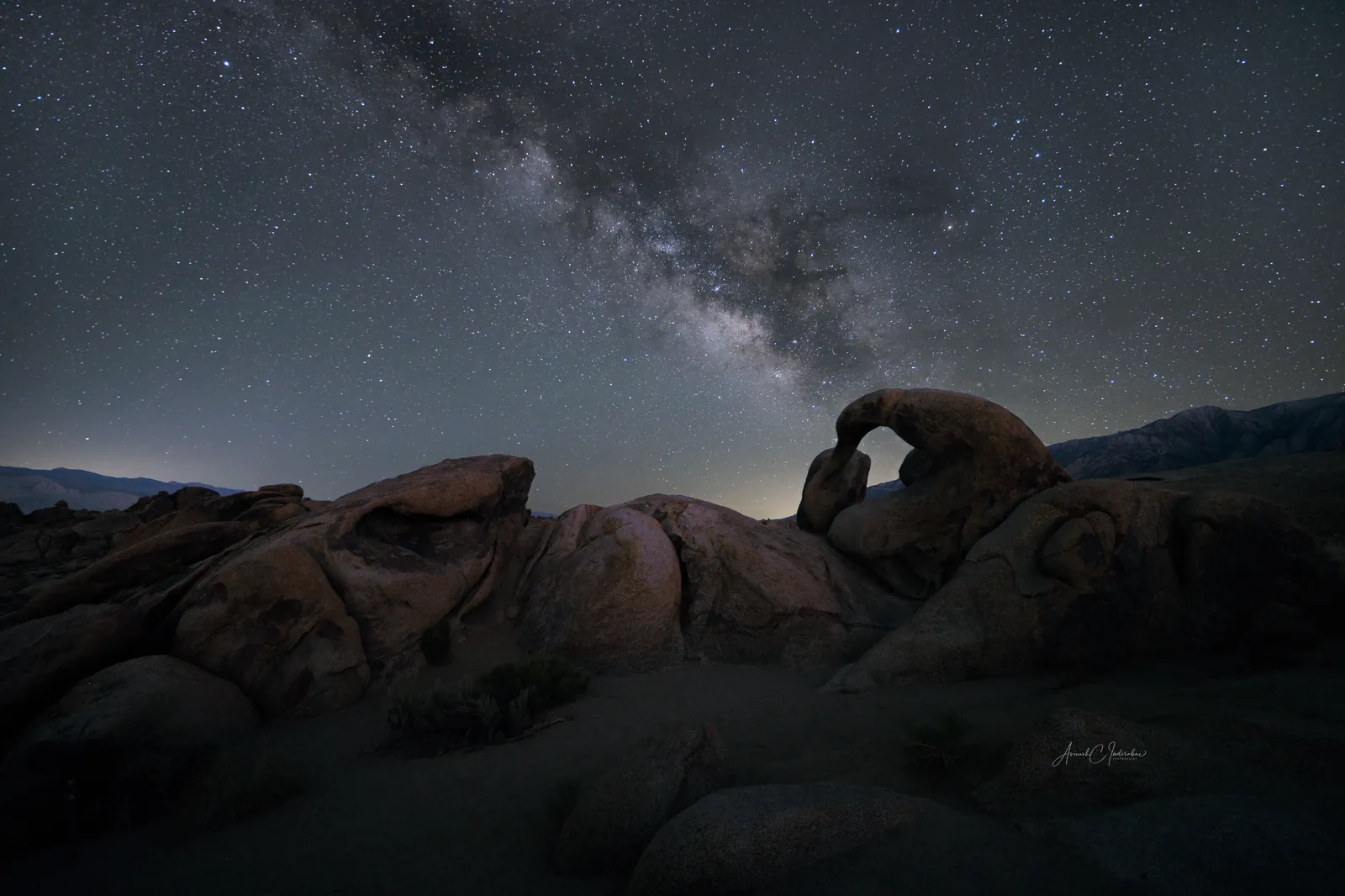
Alabama Hills, with its sculpted rock arches framing the snow-capped Sierra Nevada, gave me the kind of foreground I'd been dreaming about since Shark Fin Cove. The Bristlecone forest — home to the oldest living trees on Earth, twisted and gnarled at 10,000 feet — was something else entirely. Standing among trees that were ancient when the pyramids were built, under a sky so dark the Milky Way cast shadows, felt sacred.
I was getting cleaner tracked exposures, better compositions, and I'd started experimenting with light painting the foreground — using a dim, warm flashlight during a long exposure to illuminate rocks, trees, or other foreground elements while the tracker followed the stars. It added a whole new dimension to the images: the sky had depth, and now the ground did too.
I was also learning the subtler skills — picking the right spot based on light pollution maps and terrain, timing sessions around the Milky Way's position at different times of year, and slowly improving my post-processing in Siril and Photoshop.
After these trips, I made another investment: I had my Nikon Z6 astro-modified — a sensor modification that removes the infrared-cut filter, dramatically increasing the camera's sensitivity to hydrogen-alpha emission. The red nebulae that had been faint smudges in my images would now glow with full intensity. It was a commitment — the camera was now optimized for astrophotography at the expense of normal color balance for daytime shooting. But by this point, I knew this wasn't a passing hobby.
The Quiet Years
Between the California trips and what came next, there were seasons that just didn't happen. Cloudy weekends. Smoke from wildfire season blanketing the sky. Trips that got cancelled. Months where life was too busy and the gear sat in the closet.
This is the part nobody talks about in astrophotography tutorials. They show you the setup, the settings, the stunning result — but they don't mention the six months where the weather didn't cooperate, or the year where you just couldn't get out. The Milky Way doesn't wait for you. It has its season, and if you miss it, you wait until next year.
I kept reading, kept learning. But the camera mostly stayed home.
Joshua Tree — November 2024
By late 2024, I was living in Texas. I'd been itching to get back out under dark skies, and a friend and I planned a trip to Joshua Tree National Park. The target list was ambitious: Orion — both the constellation and the nebula — and the Pleiades. We spent weeks planning. Compositions, timing, moon phase, the works. We had it all mapped out.
Then I made a classic mistake.
A few days before the trip, I decided to update the firmware on the Star Adventurer 2i. I'd been meaning to do it for a while, and I figured — why not get it done before the big trip? The update went sideways. The tracker stopped responding. Bricked. I sat there staring at a $400 piece of equipment that wouldn't turn on, with the trip days away.
I panicked. And then I did what any sensible person would do: I spent $600 on a new tracker.
The Star Adventurer GTi arrived just in time. It was a whole new beast — WiFi-controlled, GoTo capability, more payload capacity. Everything I'd wanted. But I'd also just handed myself the challenge of learning an entirely new piece of equipment with almost no time to practice before using it in the field.
I flew from Texas to California, drove to Joshua Tree, and showed up with my Nikon Z6, the brand-new GTi, a Nikkor Z 100-400mm lens, and all the confidence of someone who has never been humbled by the desert at night.
The desert was about to fix that.
Everything That Could Go Wrong
The first night was clear. Perfect conditions. I set up at my chosen spot and started assembling the gear — tripod, GTi, camera, lens. And then I realized I'd left a couple of critical accessories back at the hotel.
I left the GTi on the tripod and drove back to get them. When I returned, the temperature had dropped into the low 40s. I powered on the GTi. Nothing. The batteries — lithium AAs that had been sitting in the cold desert air — were dead. The GTi wouldn't respond.
I assumed the worst. The tracker was broken. Brand new, $600, and dead on arrival. I spent the rest of the night in a fog of frustration, convinced I'd wasted my money on a second bricked tracker in the same month. I shot some star trails with the camera on a static tripod — beautiful in their own way, but not what I'd flown across the country for.
Back at the hotel, defeated and annoyed, I flipped the GTi's power switch one more time. It came alive instantly. The batteries had warmed up in the car. That's all it was. Cold batteries don't deliver enough voltage — you just take them out, warm them in your pocket for ten minutes, and put them back. Every astrophotographer knows this. I didn't.
I was happy the GTi worked. I was devastated I'd wasted an entire clear night because I didn't know something so basic.
The Fog Returns
I went to bed telling myself it was fine. I had a second night. The forecast was clear for both days — that's why we'd picked this weekend. One lost night was recoverable.
I woke up to a thick blanket of fog.
Joshua Tree. The desert. Fog.
The forecast had shown zero cloud cover. The sky was supposed to be perfect. Instead, I couldn't see past the campground. I stood outside and laughed — what else can you do? I'd flown from Texas, driven hours into the desert, bought an emergency tracker, lost one night to cold batteries, and now the desert itself had decided to produce fog that wasn't supposed to exist.
I gave up on the night sky plan and spent the day photographing what Joshua Tree does best in daylight — the famed Cholla cactus gardens, the twisted Joshua trees, the dramatic rock formations. When the sky cleared later in the afternoon, I got my hopes up again.
The night was hazy. Not fogged out, but not the crystal desert sky I'd planned for. I shot what I could — some decent frames, nothing spectacular. The Orion Nebula remained a fuzzy smudge. The Pleiades were there but fighting through atmospheric haze.
The Lessons That Stuck
Joshua Tree taught me more than any successful session ever could:
Never introduce new equipment before a big trip. Test everything at home, on a local outing, in your backyard — anywhere low-stakes. If I'd updated the firmware a month earlier, I'd have had time to troubleshoot. If I'd practiced with the GTi for a few weekends before flying to California, the battery issue wouldn't have cost me a night.
Never update firmware or software right before a shoot. This applies to everything — tracker firmware, camera software, processing tools. If it's working, leave it alone until you're back home with time to recover from whatever breaks.
Cold kills batteries. Keep spares in your pocket, close to your body. When equipment stops responding in the cold, warm the batteries first before assuming the worst. This is basic, and I learned it the hard way.
Weather forecasts lie. I'd learned this lesson with coastal fog in California years earlier. Joshua Tree taught me it applies in the desert too. No forecast is a guarantee. Always have a Plan B — and make peace with the possibility that Plan B might be "go home with nothing."
I didn't give up. I never considered it. I went home, kept reading, kept learning. The GTi was a good tracker. I just needed to learn how to use it properly — and give it a fair chance under better conditions.
Where Things Stand
Looking back at this journey — from pointing a camera at the sky over Santa Cruz with no idea what I was doing, to standing in the Bristlecone forest with an astro-modified camera, to getting humbled by the desert at Joshua Tree — the arc is less about gear and more about stubbornness.
Every upgrade helped. But every failure taught me more than any piece of equipment ever could. The fog at the coast. The cold batteries at Joshua Tree. The bricked firmware. The hazy nights and missed seasons. Each one added a layer of understanding that no tutorial or gear review can give you.
The GTi and the astro-modified Z6 opened a door I hadn't expected. I started thinking about dedicated optics — telescopes designed for imaging, not adapted camera lenses. I started reading about plate-solving software that could identify any patch of sky in seconds. I started wondering what was possible if I let software handle the tedious parts and focused on the craft.
That curiosity led me somewhere I hadn't planned to go.